How to Choose a Professional Slicer: 7 Key Points
News | 31st March 2023
Many criteria come into play when choosing a professional slicer . The worker's needs and preferences are just as important as the intended use of the machine and the type of food that will be sliced.
For this reason, there are different types of slicers . Over the years, models have been modified, adapted, and perfected to meet every user’s needs. Below, you will find an overview of professional slicers and their strengths to help you in your choice of a new appliance.
The essential features of a slicer
In this blog post, we will discuss seven important criteria for choosing a slicer . Before reviewing them, let's briefly look at some essential features of a high-quality model :
- Safety : Every slicer should have safety features to lock the blade and carriage in case of accidents or assembly errors.
- Motor and blade quality : It is important to check the quality of the motor , especially if you intend to use the appliance intensively. For a good domestic model, 100 watts may be sufficient. A professional slicer , on the other hand, must have a power rating of at least 150 watts . In the case of slicers for intensive use , a more powerful motor is preferable, which can reach up to 400 watts .
- Material quality : Slicers made of anodized aluminum are by far the most durable and resistant, especially if manufactured with gravity casting .
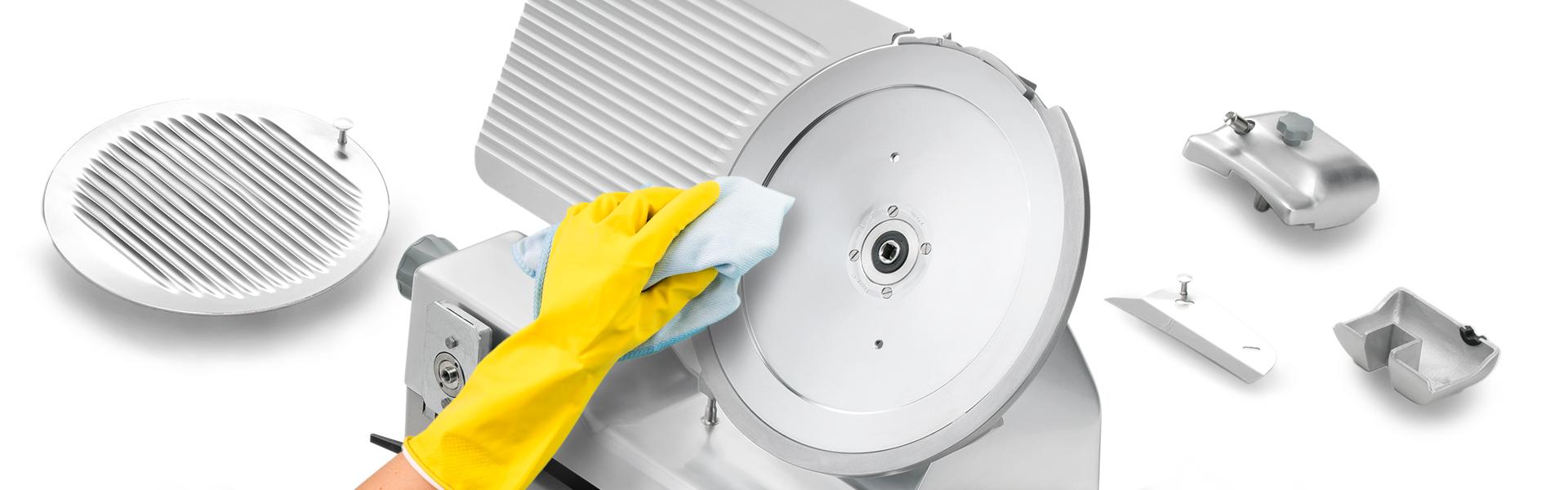
- User-friendliness : A professional slicer that is frequently operated must be easy to use, dismantle, and clean . The sharpener , which ideally should be installed on the machine itself, should also be easy to handle.
Most professional slicers meet these requirements, but it is good practice to verify before making a purchase. In domestic models, these features can not be taken for granted.
In the following paragraphs, we will list other key criteria that are linked to the user’s needs and to the specific features of the business or the products to be sliced .
1. The speed of the slicer
Working speed is an important factor in supermarkets, canteens, or restaurants with many tables, and slicing accurately and quickly is the main strength of a gravity slicer . The angle of the blade allows the product to slide down the surface on its own while being sliced. A higher or lower angle of inclination is a subjective choice influenced by various factors: the posture of the worker, the amount of space available to store sliced products, and the speed of execution. The more a blade is inclined, the more the product slides towards it, thus facilitating and speeding up the cutting process.
Our Palladio model is a gravity slicer designed for large-scale food services. It has rounded shapes to facilitate and expedite cleaning operations and is made of cast aluminium .
Gravity casting requires a high amount of molten metal compared to what will constitute the final machine. Additionally, in order to proceed to the final anodizing stage, high-quality alloys must be used. The result of the process is a superior type of aluminum that is suitable for food contact, clean, durable, and homogeneous, with increased surface hardness and strength .
Pictured: The Palladio 330 Top Slicer

2. The precision of the slicer
Vertical slicers are a high-end product . These models rely on a more complex technology , as they have two plates to move the product rather than just one. Food items are secured on the first plate and then slid along thanks to a second support surface. The portion of the product to be sliced is pushed out from the plate each time a new cut is made.
Because of this technology, vertical slicers allow for greater precision . The manual push tends to produce more consistent cuttings and is suitable for users who want to obtain slices of a very precise thickness even on large products. These slicers are also ideal for intensive use , as they allow the worker to maintain a comfortable posture and avoid bent positions, which are uncomfortable in the long term.
Our Mantegna model is a high-end vertical slicer designed primarily for restaurants. It stands out through its rounded shape and is made from cast anodized aluminum , which is then treated with an electrolytic process. This increases the machine's resistance to rust and makes it suitable for food use. It is also equipped with an on-board sharpener to facilitate and speed up sharpening operations.
Pictured: The Mantegna 350 VCS slicer

3. Blade and carriage performance
The diameter of the blade is the main factor determining the slicer's cutting capacity . Depending on the food to be sliced, larger or smaller blades may be required, with sizes ranging from 7.8 to 15 inches .
For foods with a particularly large circumference or high weight , such as certain types of mortadella, it is important to choose blades with a diameter of 13.7 inches or above . They also require high-performance, smooth-running carriages.
Many models allow blades of different sizes to be fitted, but it is important to note that cutting capacity also depends on the size of the appliance and the carriage . A larger blade allows for a greater cutting height. However, if mounted on a slicer that is too small, in some cases it can lead to a reduction in the available length and therefore to an unchanged or reduced cutting capacity.
Some SIRMAN models can mount blades of different sizes , but they are specifically designed to avoid a reduction in cutting length when larger blades are used.
The ideal SIRMAN slicers for heavy foods and for products with a large circumference are the Leonardo and Galileo models , which can be fitted with blades measuring 13.7, 14.5, and 15 inches . They also feature high-quality carriages, which remain smooth-running even under weights of 10 kg and above.
Pictured: Sirman’s Leonardo EVO slicer

4. The aesthetics of the appliance
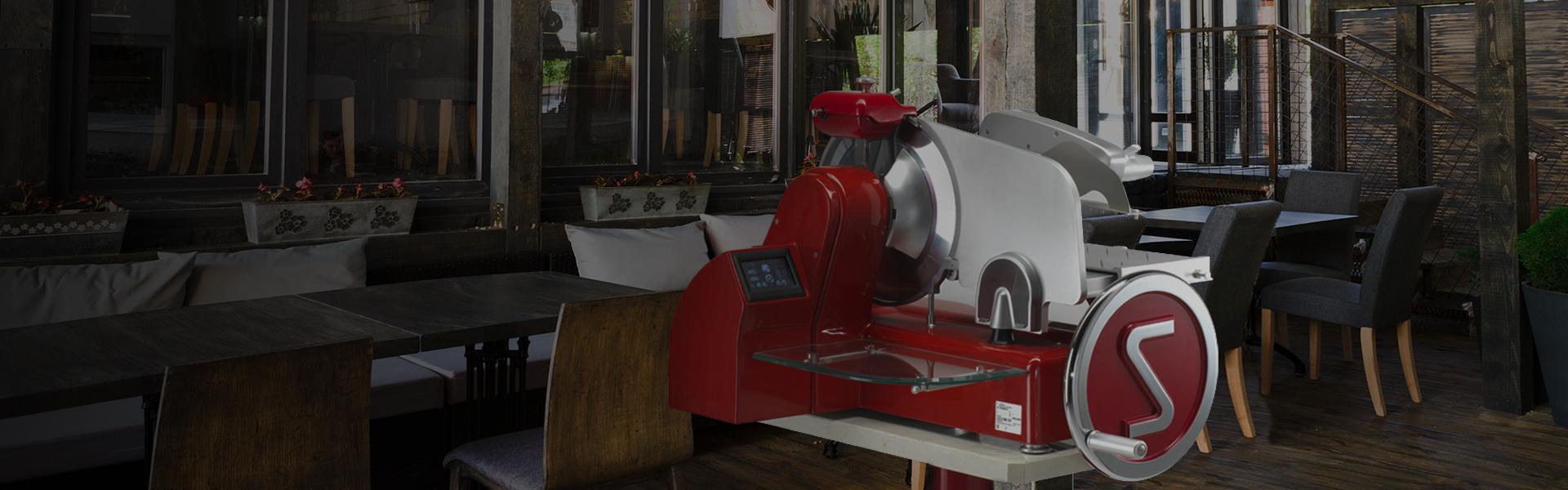
Manual flywheel slicers are fascinating machines. When prominently displayed in restaurants, they encourage customers to order dishes that require their use. At the same time, their clean lines conceal great technical complexity . In fact, the flywheel slicer is activated by hand , by turning the flywheel connected to the blade and carriage. The blade rotations then advance the carriage at a fixed ratio.
Flywheel slicers are precise and functional , but the reason for choosing this type of machine over others is linked to aesthetics. Recently, a trend for Italian charcuterie has been spreading abroad, in the form of delicatessen counters that evoke nostalgic atmospheres. Flywheel slicers are ideal for this context. Being complex machines , they are recommended for activities that involve cutting the same type of product for extended periods of time.
Pictured: Sirman’s Anniversario slicer

5. Small slicers for limited spaces
For a business with limited space , where the slicer will not be used intensively, a small model is ideal. Before purchasing, you should check the size of the assembled appliance , bearing in mind that there must be a minimum gap of 4 inches from adjacent walls. This allows for proper ventilation.
All Sirman slicers are designed to be placed on the typical tables used in the catering industry, but our catalog also includes smaller models.
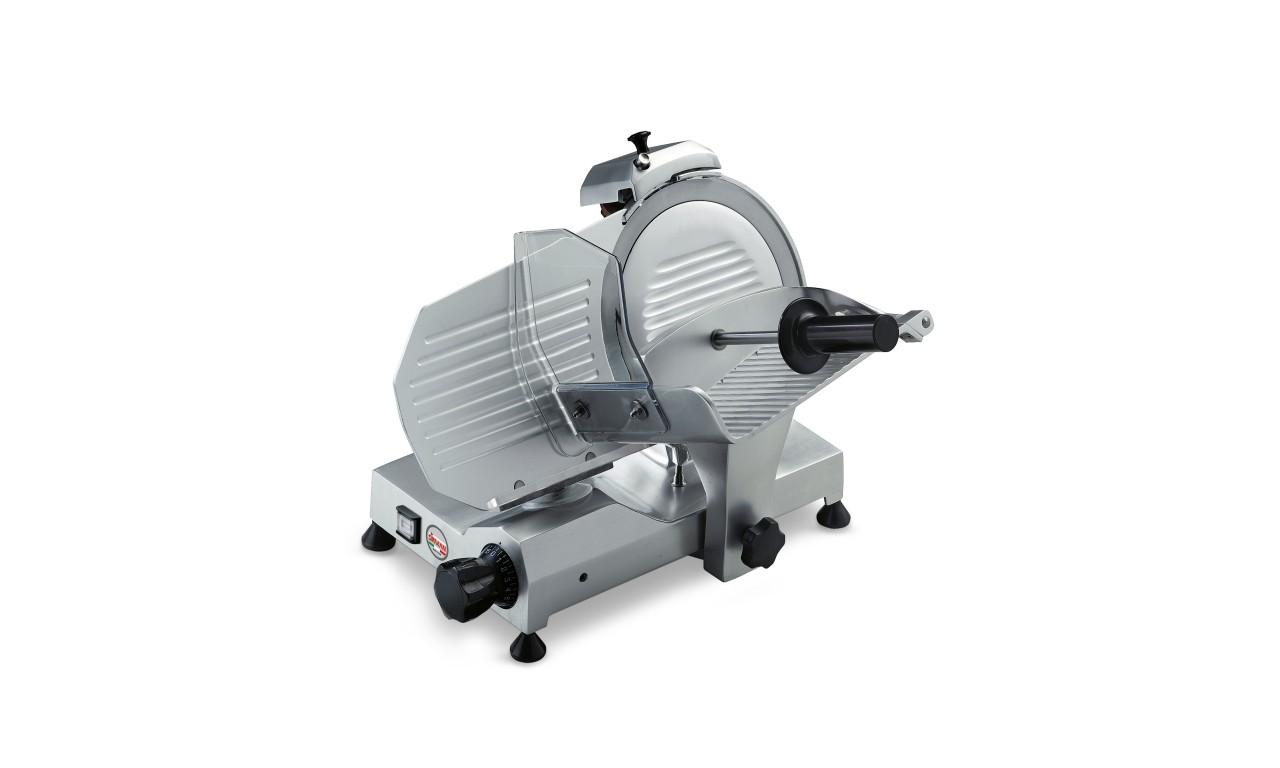
The Mirra model is a small, compact, and minimalist professional slicer . It is an electric machine, which can be conveniently positioned even in very small spaces. Practical and easy to handle due to its size, it is the best slicer for cafés, bistros, or small restaurants.
In Northern Europe, this model is highly appreciated in shops and convenience stores because it can slice small salami and charcuterie while still allowing for medium-intensity use. Like most of Sirman’s professional slicers, the Mirra model is made of cast aluminum, which is anodized in the final stage of production.
Pictured: Sirman’s Mirra 250 Plus Slicer
6. The food to slice: not just meat and cold cuts
For products other than meat and cold cuts, there are special serrated or Teflon-coated blades . Additionally, ceramic-plated options are particularly useful for products like cheese, which tend to stick and slide with difficulty at high temperatures. The version of Sirman slicers with ceramic-coated blades is called the Stonehenge line .
In addition, plates designed specifically to hold different products are available for some of our slicers, like the Palladio model . For vegetables, we created the Food Tube 2.0 , an accessory that makes it possible to cut several products at a time.
7. IoT technology
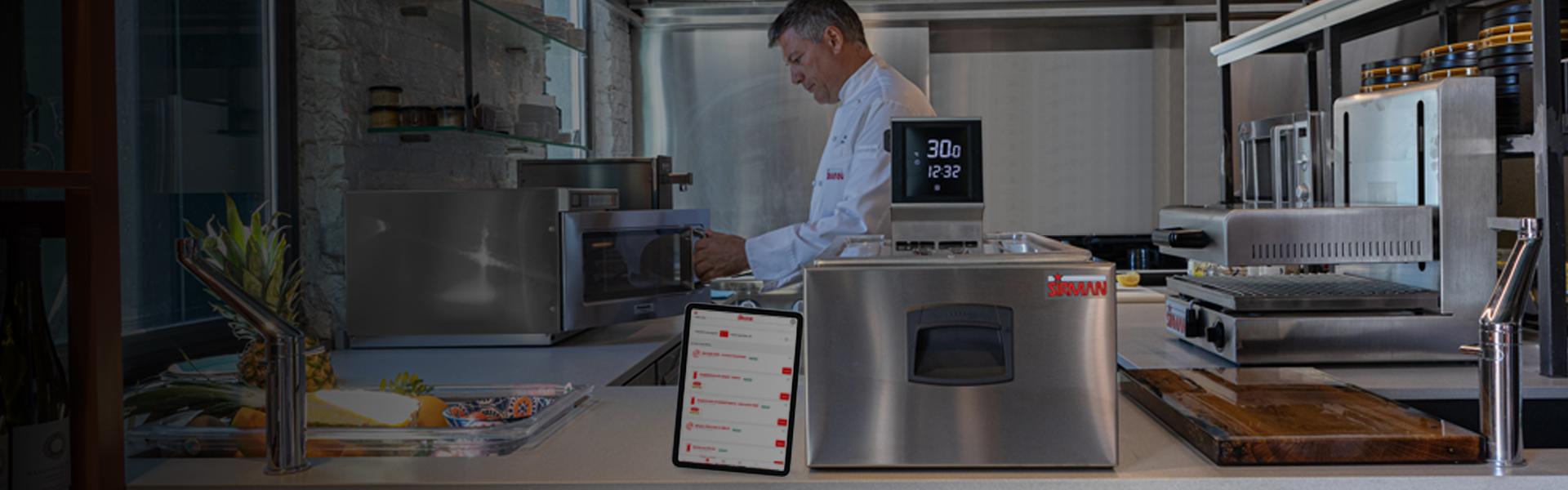
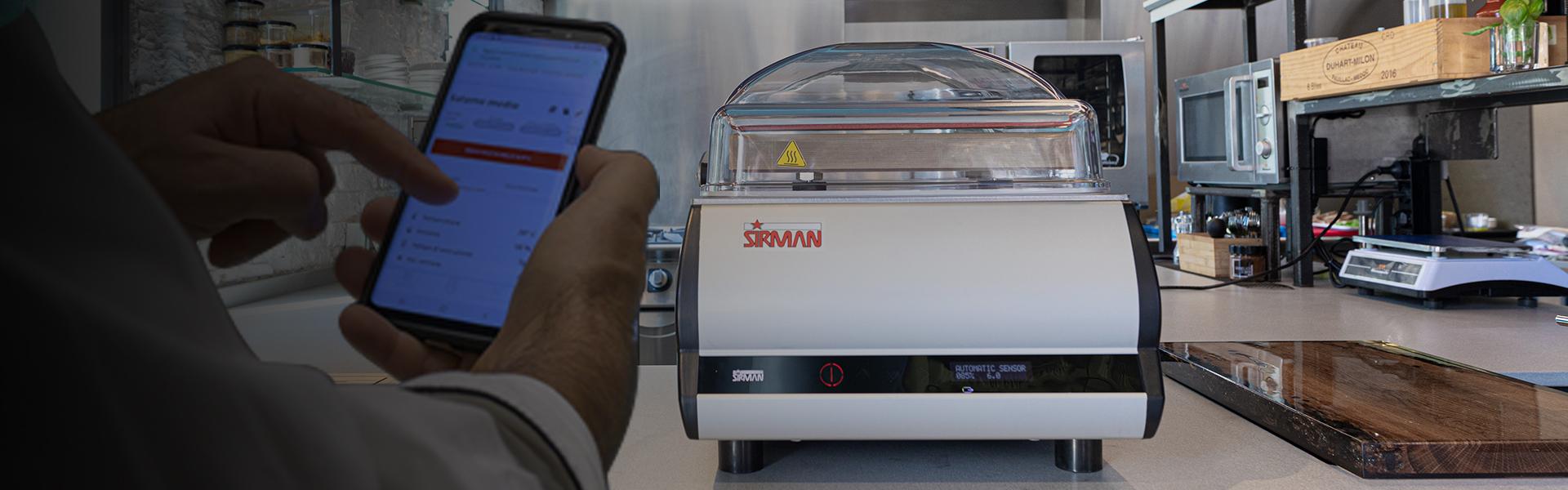
IoT technology can be applied to Sirman slicers, starting from medium-sized ones. This choice improves functionality without affecting the intuitiveness and simplicity of the machine. It monitors all machine usage metrics , including time, ampere consumption, and motor temperature. Therefore, it makes it possible to manage maintenance activities or the replacement of wear parts, such as blades or grinders, before any shutdowns occur. It also features an automatic shut-off function , as slicers are quiet appliances that are often left on.
In this article, we have explored some features of Sirman’s slicers. However, our company's real strength lies in an ability to tailor machines to different users, according to the needs and priorities of different clients . It is thanks to our expertise and investment in research and development that we can pay meticulous attention to every single detail of the slicers we produce.
Other news that may interest you
13
4th December 2025
How to obtain technical support for Sirman products, from blenders to slicersDiscover how to access Sirman support channels.
14th November 2025
How to Choose a Professional Sous-Vide CookerFind the best sous-vide machine for your business, by taking into account general and user-specific criteria.
7th July 2023
How to Clean Your Slicer: a Practical Guide to Sanitation, Maintenance, and SharpeningA clean slicer is an efficient slicer. Learn the best practices for maintenance and which models are easiest to clean.
News | 31st March 2023
The cloud kitchen: a recipe for successPartner with Sirman for cloud kitchen success. We offer cutting-edge technology, expert guidance, and innovative solutions to help you build a profitable food delivery business. Explore our resources and discover the recipe for success.
Press-room | 31st March 2023
Cloud kitchens: the future of food service?Sirman is one of the first companies to use cloud technology in kitchen appliances. The company has developed a number of cloud-connected appliances that can help to improve the efficiency and productivity of kitchens. Sirman believes that cloud kitchens are the future of food service. The company is committed to developing innovative new products that will help to make cloud kitchens even more efficient and cost-effective.
Press-room | 31st March 2023
How to choose a vacuum packing machineHow to choose a vacuum machine: types, uses, and distinguishing features
31st March 2023
How to Choose a Professional Slicer: 7 Key PointsLearn about 7 key points to help you choose the best model for your business’ needs.