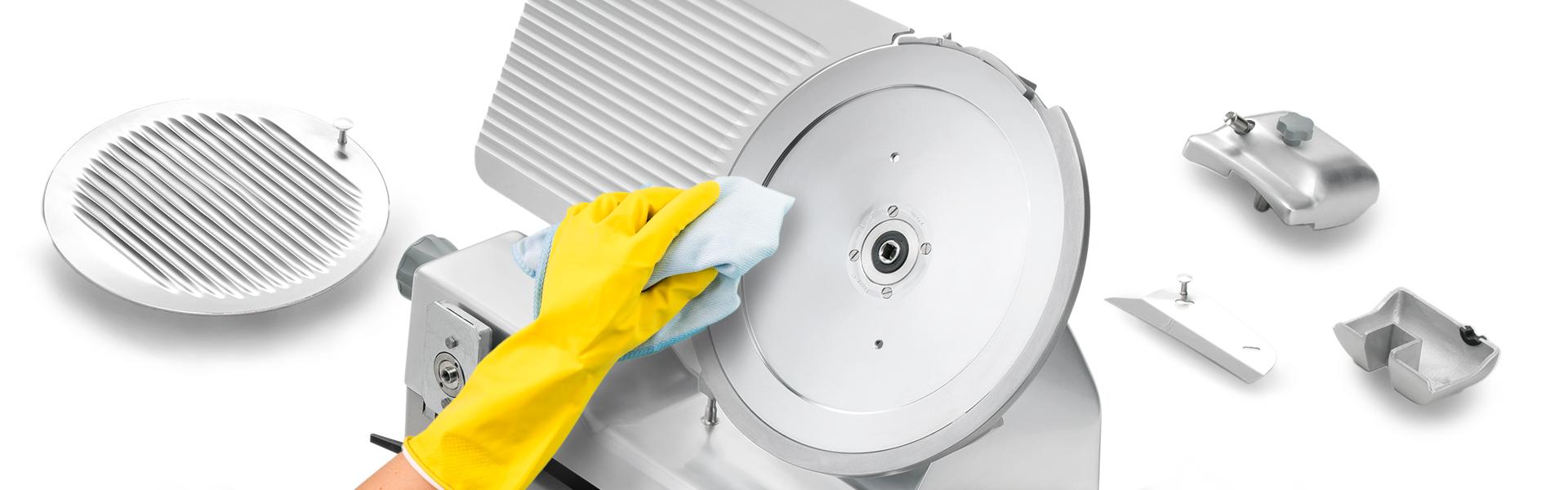
How to Clean Your Slicer: a Practical Guide to Sanitation, Maintenance, and Sharpening
News | 7th July 2023
Slicers are an essential tool for a wide variety of food preparations. Proper cleaning is just as important to ensure that the machines work well and do not contaminate the food.
Professional slicers used in butcher shops, delis, restaurants, and canteens require constant maintenance , which is simple but must be thorough. The parts of the slicer that come into contact with food must be washed daily or several times a day if the machine is used intensively.
Proper cleaning and sanitizing are important for two reasons: the efficiency of the machine and the safety of the food prepared . Cleaning and sanitizing the slicer properly extends its life, while ensuring cutting precision and excellent quality slices.
Step-by-Step Cleaning and Maintenance
To clean a slicer , whether it is a professional or domestic model, you should generally follow these steps in order:
- Switch off and unplug the machine (if it is an electric model).
- Remove all removable parts .
- Remove any food residue .
- Clean all elements, including the blade, with a soft sponge and a suitable cleaning product .
- Use the lift lever to clean the surface on which the machine rests.
- Rinse the surfaces if the cleaning product requires it.
- Wait for the slicer to dry , or dry it with a clean cloth.
- Reassemble and, if necessary, lubricate the machine .
We will explore each step in more detail in this article.
For maintenance , it is also essential to sharpen the blade and lubricate the carriage properly and regularly.
IMPORTANT : Before cleaning or servicing a slicer, it is crucial to read the instruction manual . Different machines, especially if they are not from the same manufacturer, may present significant differences , and a procedure that is correct for one model may be harmful to others.

When Should You Clean Your Slicer?
In professional settings , hygiene and cleanliness are fundamental for maintenance reasons and to ensure the safety of the food served. A professional slicer must be cleaned daily at the end of service and before any prolonged pause in its usage. This includes lunch breaks, which, if taken, bring the number of daily cleanings to a minimum of two.
What Products should be used to Clean a Slicer?
Only non-alkaline products should be used to clean a slicer, ideally without rinsing , to avoid damaging the appliance. In professional contexts, the hygiene consultant who designs the Food Safety Plan will decide which options are most suitable.
In general, it is possible to clean a slicer with alcohol . It has the advantage of degreasing and disinfecting and then evaporating spontaneously, but it is essential that the alcohol used is suitable for food contact . The pink dye in common cleaning alcohol is not suitable for food contact, and therefore it cannot be used in professional contexts. However, both in a domestic setting and in professional ones, it is possible to use clear white alcohol , provided it does not contain colorants or other substances that are not certified for food use.
How to Disassemble the Slicer: Removable Parts
All cleaning operations must be carried out with the machine switched off . Therefore, even though it may seem obvious, remember to unplug an electric slicer to ensure complete safety.
We recommend setting the slice thickness to zero before turning off the machine in order to facilitate subsequent operations and work in full safety . The blade thickness gauge will also serve as a protection for the blade wire.
After switching off the machine, proceed to disassemble all the parts that can be removed. Slicers with removable components make it easier to clean the machine, but different appliances have different structures. For this reason, you will need to check the user manual and follow the steps for your model.
In the absence of specific instructions, the correct sequence for disassembling a slicer is generally as follows: first remove the carriage, then the blade cover, and finally the blade guard.
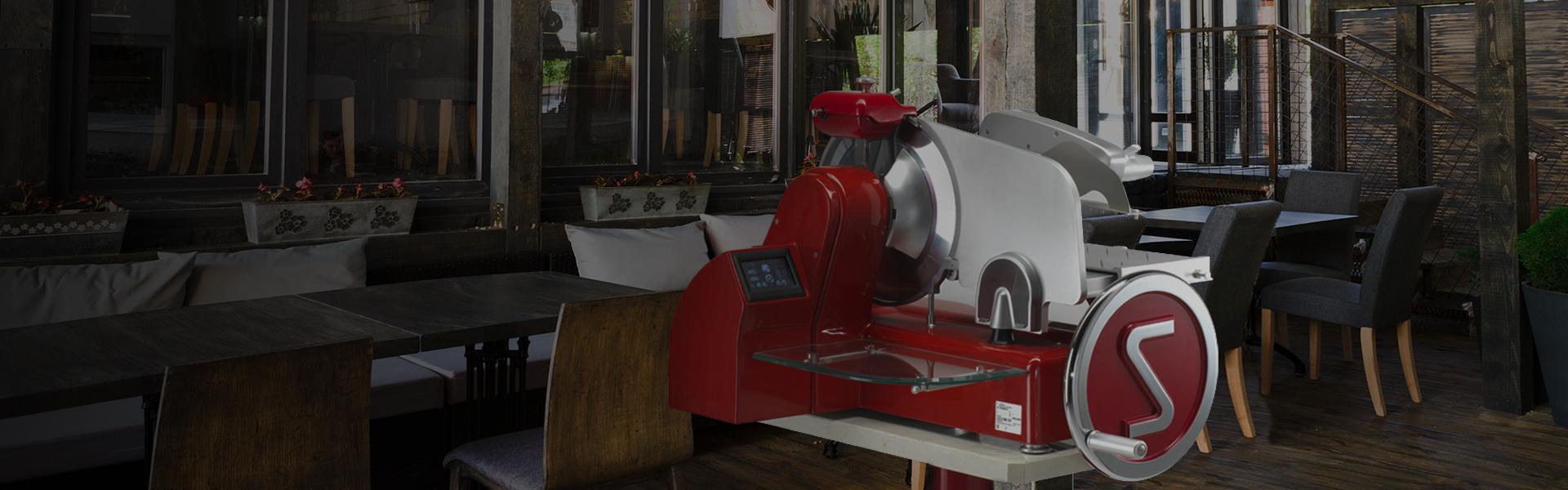
The number of removable parts and the simplicity of the operation depend on the model. In Sirman’s slicers, the carriage and all other frequently used parts can be easily disassembled and washed. This also applies to flywheel models.

Cleaning the Blade
The blade is the most important part of the slicer, and it needs to be cleaned thoroughly . It must be wiped, degreased, and sanitized regularly using a specific product , a suitable sanitizer or hot water and soap.
With a dedicated blade extractor , it can be removed for deeper and more thorough cleaning, but a carefully designed machine always provides the space needed to sanitize the blade quickly and thoroughly without having to dismantle it.
The Carriage and Machine Body
Once removed, the carriage can be cleaned separately by following the instructions for the model in use. Ceramic-coated carriages can be washed under running water or even in the dishwasher.
The body of the machine does not have to be cleaned as often as the most frequently used parts. However, it is good practice to always remove food residues with a sponge or damp cloth, as well as to eliminate all residue of detergents and dry the structure thoroughly after each cleaning.
The materials and their shape determine how easy the machine is to clean. Cleaning and drying a rounded surface is much easier than wiping the edges and protrusions of square surfaces.
In addition, anodized aluminum slicers are more resistant and durable thanks to a greater surface hardness. In this case, the material and the treatment it underwent during production facilitate maintenance.

Slicer Maintenance: Blade Sharpening and Other Tasks
After cleaning the machine properly, you can proceed with sharpening the blade . This maintenance practice is essential to preserve the quality of the appliance over time, ensuring precise cuts and reduced product waste . When the quality of the cut decreases and, at the same time, product waste increases, it is necessary to sharpen the slicer.
How to Sharpen the Blade
To sharpen the blade , set the slice thickness to zero to ensure maximum safety . This procedure cannot be performed while the slicer is in use, as it is important that the blade is perfectly clean before sharpening.
Mistakes in blade maintenance and sharpening are the primary cause of malfunctions over time. They are not immediately obvious, but they end up having a significant impact on performances. For this reason, it is essential to always carefully follow the manufacturer's instructions in the user manual and to carry out this procedure with the utmost care and attention .
Depending on the model, the sharpener may or may not be installed on the machine . Sirman has chosen to install it on all its slicers for a number of reasons . Firstly, having the tool in sight means that the blade will be sharpened more often, and it also avoids the use of sharpeners that are not compatible. Another advantage of this system is that the tool is perfectly calibrated and adjusted to the machine, avoiding the risk of incorrect positioning.
How and When to Lubricate the Carriage
While the blade is the main component of the slicer, the smoothness of the carriage also plays an important role in its use. In professional settings, the carriage of small machines should be lubricated about once a week or every 15 days , while large slicers generally have an internal reservoir that needs to be refilled approximately once a month .
The food holder and carriage of vertical slicers should also be lubricated, ideally after each cleaning.
Food-grade oils and silicone-based spray oils should not be used on slicers, as they can damage the internal mechanisms of the machine and compromise its functioning.

Common Problems: Causes and Solutions
Before getting to the end of this article, let's answer some of the most frequently asked questions about machine malfunctions . Generally, they are caused by incorrect or lacking maintenance .
Why Does the Slicer Stop while Cutting?
If the slicer jams while cutting , the problem is usually the sharpness of the blade . This is certainly true if the machine can still cut soft products, such as cooked ham, but stops on harder and drier ones.
In some cases, the issue may also occur when the food is too heavy or too large. It is always important to consider the cutting capacity of the slicer and the intended use of the model.
In addition, the speed of the carriage must be proportionate to the product being cut. For soft and small products, it is possible to proceed at higher speeds than for dry products with a large circumference.
Why is the Slicer Carriage Stiff?
If the slicer carriage is stiff, usually it has not been lubricated correctly . It is also possible that the wrong oil has been used, one that is not suitable for this purpose. To make it move smoothly again, clean the sliding axles and lubricate the carriage with a product specifically designed for slicers , especially if the machine has not been used for some time. It is also advisable to ensure that the food to be sliced is not too heavy.
Why Has Rust Formed on the Blade?
Being made of steel , the blade is the only part of an anodized aluminum slicer that can rust . This usually happens due to incorrect cleaning and maintenance . Cold cuts contain preservatives and salt , while meat is corrosive due to the presence of blood. For this reason, as well as for food safety reasons, it is important to clean the blade frequently and carefully. In retail settings, the use of highly concentrated sanitizers with incorrect dilution levels can also lead to the formation of rust.
Unfortunately, the only definitive solution in a professional context is to replace the blade , as the presence of rust can pose a food safety risk . Once replaced, it will be important to pay close attention to its proper maintenance.
Summary
In short, the most critical advice for the correct maintenance of a slicer is to follow the instructions provided by the manufacturer and included in the user manual . Each model has its own characteristics and requires specific management.
A special kit is available for Sirman models, which comes as standard on all TOP models and is optional on others, allowing users to perform maintenance activities by themselves . In addition, the company supports and assists every customer after purchase to ensure that our machines always perform at their best.
Other news that may interest you
13
4th December 2025
How to obtain technical support for Sirman products, from blenders to slicersDiscover how to access Sirman support channels.
14th November 2025
How to Choose a Professional Sous-Vide CookerFind the best sous-vide machine for your business, by taking into account general and user-specific criteria.
7th July 2023
How to Clean Your Slicer: a Practical Guide to Sanitation, Maintenance, and SharpeningA clean slicer is an efficient slicer. Learn the best practices for maintenance and which models are easiest to clean.
News | 31st March 2023
The cloud kitchen: a recipe for successPartner with Sirman for cloud kitchen success. We offer cutting-edge technology, expert guidance, and innovative solutions to help you build a profitable food delivery business. Explore our resources and discover the recipe for success.
Press-room | 31st March 2023
Cloud kitchens: the future of food service?Sirman is one of the first companies to use cloud technology in kitchen appliances. The company has developed a number of cloud-connected appliances that can help to improve the efficiency and productivity of kitchens. Sirman believes that cloud kitchens are the future of food service. The company is committed to developing innovative new products that will help to make cloud kitchens even more efficient and cost-effective.
Press-room | 31st March 2023
How to choose a vacuum packing machineHow to choose a vacuum machine: types, uses, and distinguishing features
31st March 2023
How to Choose a Professional Slicer: 7 Key PointsLearn about 7 key points to help you choose the best model for your business’ needs.